Showing posts with label thunderstorms. Show all posts

Wednesday, June 27, 2012

snails

Every time it rains, these little yellow snails come swarming out of nowhere and crowd onto our sidewalk. I never see them in the grass or on the flowers. I only see them on the sidewalk, after the rain.

I usually see two or three. Sometimes, a careless person will step on one, and i'll see the shell fragments and slime squished on the edge of a stair.

Fifty snails. Or seven. Math is not my strong suit.
Yesterday, there were TONS of them, all over the stairs and sidewalk. There was one cluster of like, fifty snails of various sizes and shades of yellow. I have never seen that many of them all at once.

I only see this kind: the little mustard-y yellow-brown with the black racing stripe. I've never seen any other ones. They never stay for more than a few hours. I go home for lunch somewhere around 1 or 2 pm, and i leave work for the day at 5. When i'm there for lunch, there are snails. When i'm home from work, there are none.

Snails are cute, sure. And they're slow-moving, and their shells are pretty and fun to decorate with, and they are delicious. Yes, i've eaten snails. Twice. Once in France, and once in Spain. In Spain, they prepare them very simply, steamed or boiled with seasonings, and you just suck them out of the shell. They are very tiny, and the method of cooking usually leaves their heads poking out of the shells, their tiny faces frozen in a series of silent screams. Spanish snails are pretty upsetting to eat. French snails, on the other hand, are baked or roasted in a thing like a muffin tin, each snail in its own little compartment, and they are neatly tucked into their shells and covered in butter and herbs. You eat them with a fork, and you never have to see their faces. This way is much better.

I have to confess, however, that i fibbed a little when i said that snails are delicious. The truth is that, much like octopus, snails don't have much flavor beyond what they're cooked with. This is another reason to prefer the French method: they mostly taste like melted butter and herbs.

But these little guys are not for eating. I just like to watch them enjoy the sunshine.

Friday, September 9, 2011

but not like the snow

oh, kiss me like the rain, love
like a drizzly spring morning
gradual and tender
envelop me

oh, kiss me like the rain, love
like a summer thunderstorm
sure and unyielding
capture, overwhelm me

oh, kiss me like the rain, love
like a september shower
a soft touch on warm skin
take me by surprise

Friday, July 8, 2011

roots and wings


I spent the first seventeen years of my life on the Eastern shore of the Chesapeake Bay in Maryland. It's a beautiful area of the country, with Colonial houses, majestic rivers, sailboats, wildlife, cornfields, star-studded skies, and lots of rednecks.


I loved growing up there. I loved living near the river, smelling the marsh mud (nostalgia always smells sweet, whatever the reality) and watching the herons. I loved the feeling of endless space, of clean horizons. The corn and soybean fields went on forever, except where interrupted by deer or some picturesque trees. I loved eating fresh fish and venison. I loved eating corn-on-the-cob from my great aunt's garden, and steamed crabs from the Bay. I loved the black-eyed susans, the brick sidewalks, the heavy humidity, the scrapple, the biscuits with dried beef gravy, and the Ravens. (How can you not like a team named in honor of Edgar Allen Poe?)

I love my family. My mom's side of the family is large, loud, and invasively affectionate. They will feed anyone who enters the door (or even anyone who comes near the property line; my grandmother has frequently made plates of sandwiches, watermelon, and leftover cake for the garbage men). They all live within a twenty-mile radius of one another. They all talk at the same time. They all bicker constantly. They all pry into my private life. Several of them are outstanding cooks. They have all given me money at least once, whether as a gift for graduation/birthday/other special occasion or just because i am young and sometimes tight on cash. I have crashed on their couches, bummed rides to work with them, accepted hand-me-down furniture from them, politely turned down hideous hand-me-down furniture from them, and become friends with them on Facebook. And i have only had to put one of them on restricted access so far.

I love my immediate family, too. But my dad lives in Delaware. My brother is in Afghanistan. One of my sisters is only a year away from graduating and starting college, and the other one is seven and a half years younger than i am. As we both grow older, that gap matters less and less, but twenty-one and fourteen are still worlds apart. My mother's recent marriage to a guy i barely know makes the house even more awkward to be in. I no longer have my own bedroom, so i stay in my brother's room with all of his half-packed things from college and childhood.

And after a while, those endless horizons start to feel oppressive. Sure, you have no limits, but that also means that you have nowhere to go. My town has one movie theater. The second nearest one is thirty miles away. The nearest mall and Walmart are in the same town as the second movie theater. There are no museums, no concert venues, no public transportation, and no Starbucks.

Yeah. That's actually the whole town.


I have spent the last four years of my life near Boston.


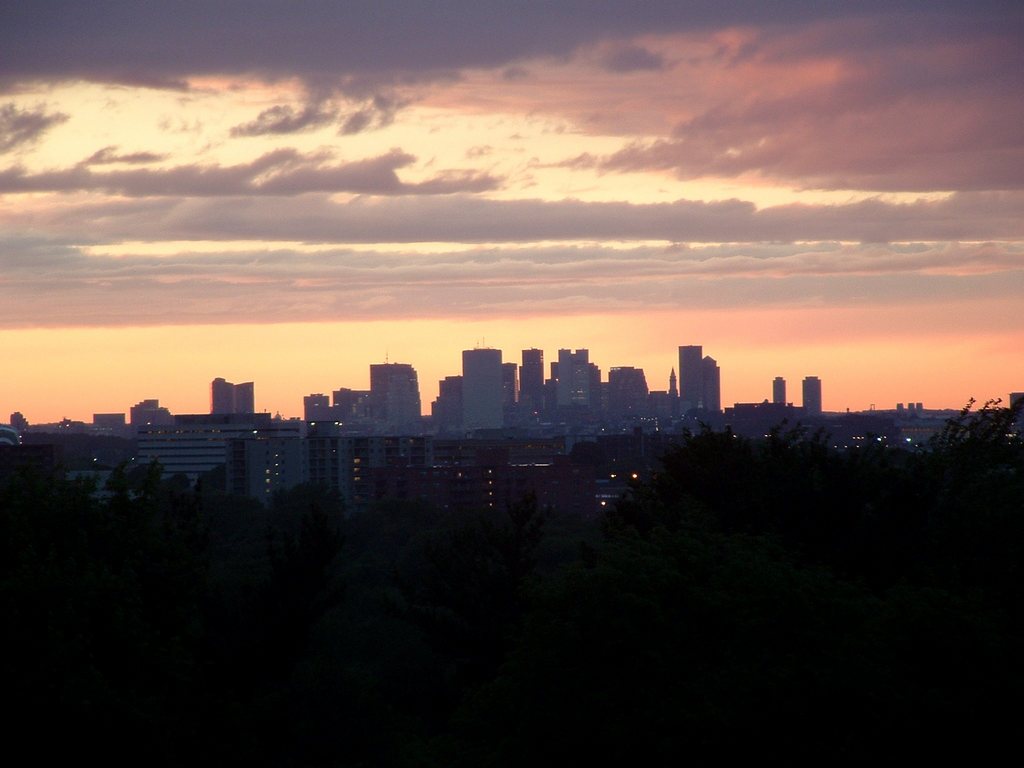
I can see Boston from my roof (though not as clearly as in the above image). There are four coffee shops within walking distance of my apartment, as well as two cupcake shops, several bars and restaurants, and a Marshalls. And a five-minute walk brings me to the train, which can take me anywhere i want in Boston. I can go to theaters and museums, attend concerts, shop, tour the historic Red Line, eat fabulous food, and pretend that i go to Harvard. This 4th of July, my roommates and i hosted a cookout which culminated in watching fireworks from our roof, over the Boston skyline.

My family isn't so very far away, and they're not even in a different time zone, so it's not terribly difficult to talk to or visit them. The only real difficulty is that, as i mentioned before, i'm not the only one who no longer lives in my mom's house. But we make it work.

I have lots of friends here. I have a job here (for now, anyway). I'm enrolled in grad school. I have a church family. I have a boyfriend. I have a cat.

There are a lot of things that keep me here. There are a lot of memories, a lot of possibilities, and a lot of really delicious cupcakes across the street from my apartment.

But sometimes, when i'm sitting on the roof and gazing at the Boston skyline, i hunger for stars. Sometimes, when i'm at the beach with friends, i think of Maryland blue crabs steamed with Old Bay and my mouth waters. I long for thunderstorms that make the windows rattle and that last for hours. I long for humidity so intense you can barely move. I long for old men in pickup trucks who wave (in a friendly, non-creepy way) when they see you out for a walk. I long for my family, blowing my personal bubble to smithereens with their very presences. I long for goose-calls in the fall, for Queen Anne's lace in the summer, for mild winters where school is canceled because of forecasted flurries, for springtime full of wildflowers.

My roots run deep and my wings reach far. At times i feel like i will be torn in two by the opposing forces.

When i was sixteen, my dad took me out to dinner to give me a blessing, Old Testament-style. He said a lot of really great things, but the one that stuck was that i was a willow tree. He told me that willows look beautiful and graceful and delicate, but that their beauty conceals an iron strength. The roots of willow trees often force their way through concrete barriers into swimming pools or drainage pipes, all in a quest for water. They are tough enough to break mower blades. They are very tenacious and difficult to remove.

My dad said, "You are a willow. You won't let anything get between you and the things that you want and need. You will break through any barrier, block any blow, and hang on to the very end." The way that he talked about roots made them sound almost like wings. I liked that.

I have written before about my swallow tattoo, about how the swallow uses its wings to return home. When i read about swallows, their wings sounded almost like roots. I liked that.

I don't know what the future holds. I can't say that i will never again live in Maryland. I can't say that i will live in Massachusetts forever. I can say that, wherever i live, i will be torn. I will feel out-of-place and homesick. I will dig in my roots, desperate for sustenance and refreshment, and i will spread my wings, longing for the next horizon.

Tuesday, June 21, 2011

Veritas? Quid est veritas?

"Truth? What is truth?"

However crazy Mel Gibson may turn out to be (he just keeps raising the bar for himself, doesn't he?), you can't deny that he got it right at least once. For those of who who have not seen The Passion of the Christ, the quote that titles this post may be confusing. It is spoken by Pilate to his wife as tries to decide whether or not he should have Christ executed. (Side note: if you haven't seen it, you should. It's really a great movie.) Truth is a tricky concept. Some say that there is no such thing. Some say that truth exists, but that it is different for every person, or that it changes across cultures and times. Some think that it exists, but that we will never be able to pin down a satisfactory definition of it while in this imperfect world.

It's an important question. We need to know what truth is, so that we can decide what to teach our children in schools, so that we can decide which leaders to elect, so that those leaders can make executive decisions about laws and wars and social justice. We need to understand truth so that we can relate to one another in constructive and harmonious ways.

Christians need to understand truth because we need to know how to read the Bible. There are some passages of the Bible that are clearly meant to be taken metaphorically (such as in Job 38, where God talks about the ends of the earth, or the storehouses of snow and hail, or the gates that hold back the seas). In fact, there are so many passages that are either full of poetic hyperbole or are limited by the cultural and historic understandings of the authors (ancient Jews), that it can be hard to pinpoint which, if any, are meant to be taken literally.

The big question on the lunatic fringe of both Christianity and secularism is the question of creation. When the Bible says that God created the world with nothing but the power of His words in six days, does that mean that in six 24-hour periods, life as we now know it sprang forth from the void, or does that mean that life has passed through several stages, all of which were planned, executed, guided, and intended by God?

There are plenty of writings to address that particular question, but the real problem is this: the question is not "How was the world created?" but rather, "How can we believe that the Bible is true and accurate if we can't take everything it says literally?" I have my own opinions on that topic (addressed more fully elsewhere), but my real frustration here is a question of vocabulary.

Tim O'Brien's The Things They Carried has a passage about the difference between story-truth and happening-truth. It's a wonderful and somewhat tricky concept, and i recommend the book (because it's awesome, and also does a good job explaining this concept), but for now i will do my best to sum it up briefly.

Story truth (hereinafter referred to as "truth") is something that speaks to a real experience, even though it didn't necessarily happen. For example, in this post i tell a story about sitting on my grandmother's porch swing during a thunderstorm. Everything that i say in that post is real. I have a grandmother. She used to have a porch swing. There is a window behind the swing that once broke when someone swung back too far. We used to count the seconds between lightning and thunder in order to calculate the distance of the storm.

But that post is not based on one particular moment. It is a collection of moments, an impression of many memories. My grandmother moved out of that house when i was nine, so many of my memories of that house have run together into one big story. And i was certainly not reflecting on the fleeting nature of joy, or on the differences between joy in childhood and adulthood, or anything of the kind. I was counting the miles.

That post is true. It is full of "truth". But it is not a factual event. It is not a newspaper article of one particular storm. It is not an historical account.

On the other hand, let me tell you a story that displays "happening truth" (hereinafter referred to as "fact"). When 2000 came, my siblings and i were spending the night at my grandmother's house. I was a little disappointed that all electronics did not instantly explode (or whatever the new millenium threatened. People got a little hysterical in 1999). But i remember thinking, "At least we can still watch cartoons in the morning." And i remember trying to sleep while the German exchange student played computer games.

That story is pure fact. Those things really happened. Those are true, concrete memories, not a pretty quilt patched together from fragments of memory and nostalgia.

The whole Bible is true. But not all of it is factual. Some parts of it, while they tell great stories to illustrate points, are not based on anything that ever actually happened. Some parts of it use metaphor to make a point. Some parts give us guidance for our behavior by embroidering what happened.

So how do we know which parts to take literally and which parts to take metaphorically? To tell you the truth, i don't think it's all that important to make a distinction between fact and truth in the Bible. I think that all of the Bible is true, and that it is therefore all useful for instruction and guidance in the Christian life. But as long as God is speaking to you through Scripture, does it really matter whether He is using history or poetry to do so?

Thursday, June 16, 2011

Counting the Miles

Lightning flashes.
“Seventeen . . . eighteen . . .nineteen . . .twenty . . .”
Thunder rolls.
Four miles, Mommom!”
Four miles doesn’t mean a lot when you’re six. You understand vaguely that it’s a long way to walk, but a short way to drive, and you don’t spend a lot of time worrying about it.
Especially not right now. Right now, you’re focusing on the storm. Raindrops strike the roof and sidewalk like bullets, streaking furiously past the windows.
The swing creaks; the sound familiar and reassuring in the chaos of the storm. We whisper to one another, “Remember when the swing crashed through the window?” and glance excitedly at the Plexiglas behind us: the window into the cozy, well-lit living room. The window seems ominously near, and very fragile. We slow the swing and snuggle closer to Mommom.
Lightning flashes.
“Nine . . . ten . . .”
Thunder rolls.
“Two miles, Mommom!”
“Yes, it’s getting close,” she says, generously joining us in our excitement.
Everything is exciting when you’re six. You haven’t yet learned that good times end, that people move to new places, that you have to grow up.
You’d think, having learned this, that adults would be even more excited than children, that they’d want to make the most of their joy while it lasts. Instead, they mourn the good times gone.
Lightning flashes.
Thunder rolls.
The storm is upon us.